
Best (and most questionable) decisions of last offseason
Looking at free agent signings, draft picks and trades that either worked out great for WNBA teams or have gone sideways


Thanks for reading the Her Hoop Stats newsletter. We’re excited to announce a new partnership with Hudl. Hudl’s industry-leading tools - Sportscode, Instat, and Fastmodel - elevate the preparation, performance, and player development of WNBA and NCAA teams. We appreciate their support and look forward to working with them to help bring more insight about the women’s game to you.
You can find me on Bluesky and Twitter and you can find HHS on Bluesky, Twitter, YouTube, Facebook, and Instagram.
Haven’t subscribed to the Her Hoop Stats Newsletter yet?
We have reached the point in the WNBA season where we have a big enough sample size to start drawing conclusions about teams and players. We also have enough games played to use some hindsight and look back at the decisions that were made in the chaotic offseason and analyze whether teams got them right or appear to have made mistakes.
Let’s dive in..
The best decisions
The Lynx signing Natasha Howard
The Lynx acquired an All-Star starter for $700,000. Whew. Howard’s fit with No. 2 overall pick point guard Olivia Miles on pick-and-rolls has been nothing short of art to watch. Howard’s combination of length, quickness, finishing ability and experience makes her the perfect partner for a rookie to play off, and the vet has been a great finisher.
She has 123 shots made inside of five feet from the basket, which is No. 1 in the WNBA by 20 over the next best close-area scorer (Kamilla Cardoso).
Howard has always been a great defender, winning Defensive Player of the Year in 2019, but this year her assignments have been harder than ever as she’s been asked to play center with 6-foot-5 Dorka Juhasz sidelined. Howard has been up to the task, grabbing 8.0 rebounds and 1.7 steals per game.
Overall, she’s fifth in the WNBA in win shares. Her 17.2 points per game may decline when Napheesa Collier returns, but the Lynx couldn’t have drawn it up any better to have Howard fill the void en route to a 15-6 start.
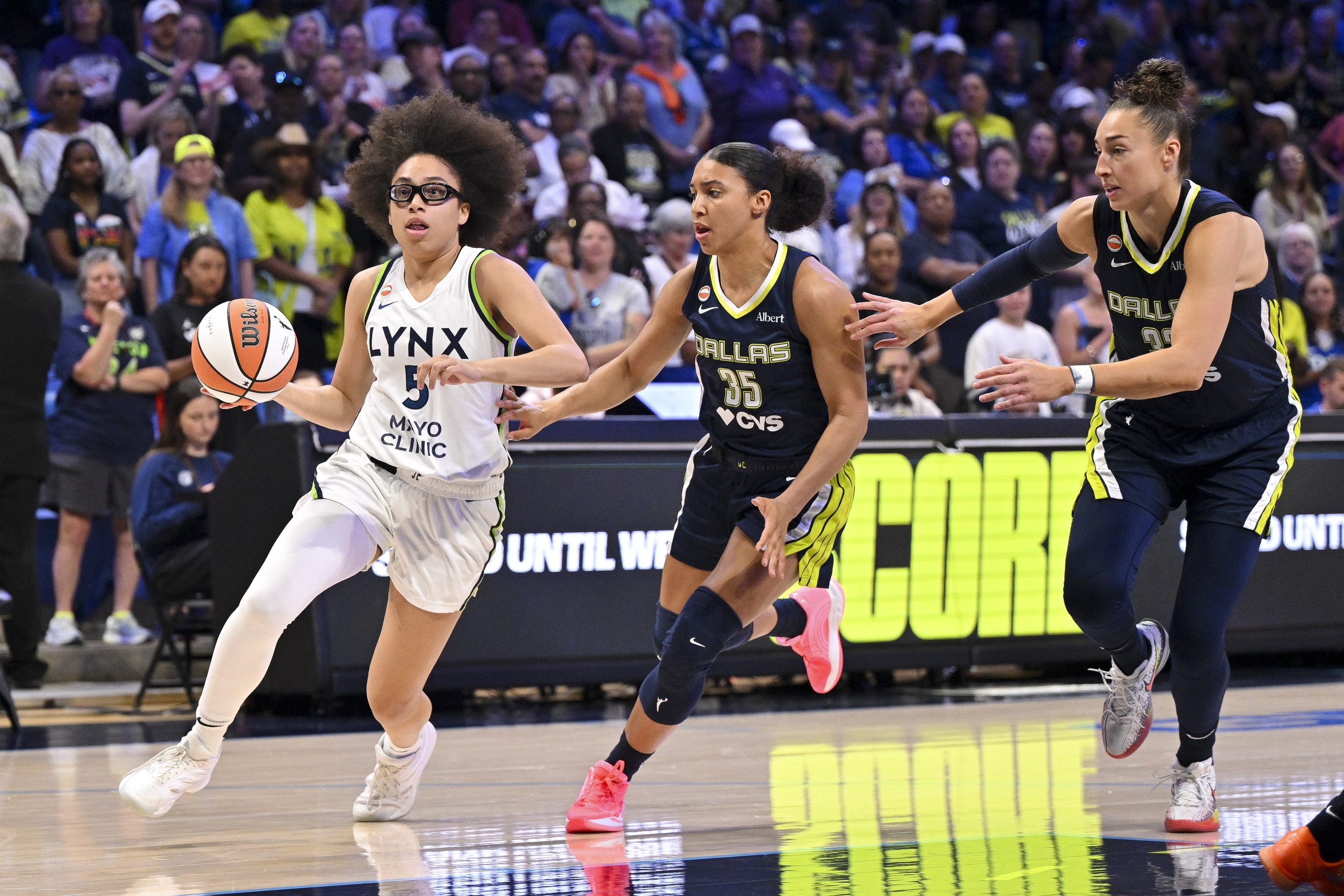
The Lynx drafting Olivia Miles
Here are the players with better win shares per 40 minutes than the rookie: A’ja Wilson. That’s the list.
We have seen a lot of rookies shine in the WNBA, but there are only a handful that have been like this. Miles is evoking memories of Candace Parker winning MVP as a rookie. The Lynx point guard is averaging 18.5 points per game on 50.7% from the field and adding 5.7 assists per contest.
Miles’ contributions go beyond the box score. She has been the centerpiece of an offense that was completely reshaped after losing Alanna Smith to free agency and Collier to injury. She was thrown into the fire to handle the ball on every possession and bump Courtney Williams over to shooting guard. Miles’ creative passing, terrific vision, and ability to blow by hesitant defenders to finish at the rim have been a perfect fit for bringing Reeve’s vision for the offense to life.
Usually when teams draft No. 2 overall, they get there by being bad. This was a case of foresight by Reeve, though. Her pick swap with Chicago that allowed the Sky to move up and take Angel Reese ultimately led to Miles becoming a Lynx. Considering Chicago’s recent history with front office decisions, it was a pretty good bet to swap picks with them. Minnesota hit the lottery by doing so even if it took some heat in the short run for not taking Reese.
The Lynx signing Nia Coffey
So many players in the WNBA have their success or failure shaped by the situation that they land in. Over the last two years, Nia Coffey played under 15 minutes per game, shot under 30% from 3-point land and committed too many fouls when she did see the floor. With the Lynx, she has been a very good three-and-D player while filling in for Collier.
Coffey, who did have two seasons of 40% or higher 3-point shooting, is averaging 8.9 points per game on 41.5% shooting from downtown to go along with 6.1 rebounds and 1.4 blocks per game.
When Collier returns, Coffey’s role will be reduced, but she should still provide a strong rotational presence at the small forward or power forward positions and give the Lynx more depth and lineup flexibility.
New York signing Pauline Astier
Expansion and higher paychecks have appeared to open up the WNBA to more overseas talent, and the Liberty are benefiting greatly with Pauline Astier. During the early part of the season when Sabrina Ionescu was out, Astier gave them scoring and playmaking, and now with Ionescu back, she gives the Liberty lineup flexibility and scoring depth.
Astier is averaging 10.0 points and 3.8 assists per game while shooting 55.3% from the field and 40.0% from beyond the arc.
One thing the Liberty can do with Astier’s ability to control the basketball is get Ionescu away from having to have the ball in her hands all the time. If Astier is controlling the offense, Ionescu can get off-ball screens or set up for catch-and-shoot 3-pointers rather than allowing opponents to trap her or wear her down over the season with physical play.
Dallas signing Jessica Shepard
Who would have guessed Jessica Shepard would lead the WNBA in win shares through almost half the season? Not that there weren’t signs that Shepard could be even better if she got more opportunity outside of Minnesota, but she has turned into Dallas’ version of Alyssa Thomas as the “point forward.”
Shepard is scoring 14.6 points per game and ranks in the league’s top 10 in rebounds per game (second behind Angel Reese) and assists per game (10th). Over the last five completed seasons, no player besides Alyssa Thomas has finished a season in the top 10 in both rebounds and assists per game.
It seems the combination of Shepard’s development over years of playing for the Lynx (and overseas) and the clear plan that Wings head coach Jose Fernandez had for Shepard to take advantage of her passing ability has paid off.
The Wings have the option to use handoffs and pick-and-rolls with Shepard, or they can run off-ball screens for Paige Bueckers and Azzi Fudd and lean into Shepard’s passing skill.
Dallas drafting Azzi Fudd No. 1 overall
With Olivia Miles setting the world on fire in Minnesota, it’s easy to say that Dallas should have taken her instead of Fudd, but just because she has been overshadowed by the No. 2 overall pick doesn’t mean it was the wrong choice.
Fudd was expected to immediately be a highly efficient sharpshooter, and she’s become just that. She ranks inside the top 10 among guards in terms of overall field-goal percentage, and she’s knocking home 36.9% of her 3-pointers while attempting 4.9 per game. She is also fourth in the W in steals per game.
As Fudd increasingly becomes comfortable playing the WNBA game, we can expect these numbers to continue to rise. The Wings had a lot of options with the top pick, but they should have no regrets.
Toronto taking Marina Mabrey in the expansion draft
The theme of the most praiseworthy pickups is finding players that would thrive if their roles were expanded. That’s Marina Mabrey. She has always been a talented offensive player, averaging 14.4 points per game in each of the last two seasons, and outside of 2025, Mabrey has been an efficient 3-point shooter (37.7% in 2024 and 39.0% in 2023).
Now that she has to be relied upon for the majority of her team’s scoring with rookie Kiki Rice and scorer Brittney Sykes banged up, we are seeing maximum Mabrey. She’s fifth in the WNBA in points per game (21.1) and is shooting 39.9% from beyond the arc while taking the second most 3-point attempts (8.8) per game.
Toronto might not have a deep enough roster to compete for a championship in Year 1, but Mabrey has given fans a reason to show up every night. She’s under contract through next year, so they can build around her scoring prowess.
Golden State signing Gabby Williams
Under Natalie Nakase, Golden State has created a clear identity. They play slow on offense and grind you to death on defense. Gabby Williams’ speed has made them an even more dominant defensive team and added a different dimension in transition with her baseline-to-baseline speed. She has also adjusted her own game to focus on shooting from beyond the arc.
As a Valkyrie, Williams is averaging a career-high 15.3 points per game. Despite taking the most 3-point shots of her career by a wide margin, she’s still shooting a career-best 35.7% from beyond the arc.
On defense, Williams is sixth in the league in steal percentage and seventh in individual defensive rating.
Golden State should be thrilled with signing the former UConn standout.
Portland picking Carla Leite in the expansion draft
Last year, Leite got a fair amount of playing time with Golden State but struggled with efficiency. She only played 17 minutes per game and made just 13 of her 75 3-point attempts as a Valkyrie (17.3%). This year, her shooting has started to come alive, going 16-for-39 (41.0%) and knocking down 88.7% of her free throws on 6.1 attempts per game.
In total, she’s up to 25.5 minutes, 15.4 points and 5.6 assists per game. That’s enough to crack the top 25 in offensive win shares.
The fact that the offensively gifted point guard is only 22 years old is an even bigger win for the Fire because she can become a key piece at point guard for them for years to come.
Seattle drafting Awa Fam
Not that it was likely a difficult decision considering the 20-year-old’s talent, but Awa Fam has made it very clear in her early performances that Seattle has a future star to build around. In her first 17 games, she’s averaging 11.7 points and 5.1 rebounds while shooting a remarkable 58.7% on 2-point shots and 39.1% on 3-pointers with a fairly big sample size of 64 attempts.
The Storm don’t have a very good record right now, but pairing Fam and sensational big Dominique Malonga together for the future is going to be scary for opponents.
The most questionable decisions
Golden State not keeping Flau’jae Johnson
With the Valkyries having a great start to the season, it’s hard to nitpick away at their roster decisions. However, the hindsight on their call to trade Flau’jae Johnson to Seattle to move back in the draft and then select a player who didn’t even make their team doesn’t look great at the moment.
Golden State doesn’t have the best scoring depth, and Johnson has begun to show signs of adjusting to the WNBA, producing games of 28, 24 and 23 points versus New York, Atlanta and Los Angeles, respectively, within the last two weeks.
While Johnson has struggled with her efficiency in her rookie year, she’s flashed enough highs to demonstrate that she can even out her ups and downs in the coming years. Golden State is a new franchise, but it’s a veteran team overall and foregoing the opportunity to develop a young player remains a suspect decision.
Dallas bringing back Arike Ogunbowale
Signing Arike Ogunbowale to a two-year deal for the maximum dollars when the Wings knew that they were going to draft Fudd with the No. 1 pick and have a budding guard in Aziaha James in the mix was confusing when it happened and still looks perplexing in hindsight.
Dallas has not been able to figure out Ogunbowale’s fit within the offense. She has always struggled with efficiency, but this year has been a disaster. The former Notre Dame star is shooting just 33.6% from the field.
Out of 82 players who have at least 12 games played and average 20 minutes per game, Ogunbowale is 74th in points per scoring attempt and 78th in effective field-goal percentage.
The disturbing part of her numbers is how many midrange shots she’s taken and how terribly she has shot in those areas of the court. Between 5-15 feet from the bucket, Ogunbowale is 13-for-55 (23.6%) and she’s 6-for-27 (22.2%) between 15 feet and the 3-point line. In a league that’s moving away from those shots, she’s taking them at some of the highest rates in the league and missing constantly.
The only thing Dallas can hope to do is figure out a role in the offense that works better for her. Nobody has been able to solve this problem yet, but it shouldn’t be this bad.
Trading Ogunbowale is an option, but getting someone to take her contract seems like a long shot.
Dallas signing Alanna Smith
On paper, it made complete sense for the Wings to bring in a stretch-four who is a great defender and tough as nails. In practice, it hasn’t worked out at all. Smith is averaging just 15.0 minutes per game and scoring 4.1 points. She has made just 7-of-35 attempts (20.0%) from 3-point land after hitting 100 threes over the last two years for the Lynx.
Dallas can only hope she will find her groove in the second half of the year, but considering she was given top dollar, the bar is high to make this deal worth it.
Chicago trading a first-round pick for Jacy Sheldon
Giving up a 2028 first-round pick for a player who averaged 7.5 points per game last year was pretty baffling, but the fact that Sheldon is only getting 22.2 minutes per game and taking 5.7 shot attempts per game with Chicago this season makes it even more bizarre.
Over her young career, Sheldon had already bounced around to three different teams who struggled to find the right fit for her. She would be a fine player to acquire for a later-round pick, but giving up a first-rounder may be repeating the same mistake they made with the Lynx trade that landed Olivia Miles in Minnesota.
Chicago signing Skylar Diggins
Skylar Diggins has often struggled with efficiency throughout her career, but this year has been a nightmare. Out of the 82 players who have played at least 12 games and average 20+ minutes per game, she ranks 68th in field-goal percentage and 79th in 2-point attempt percentage. This week, the Sky announced that she would be coming off the bench.
If the team were deeper, it’s possible that she would be more discerning with her attempts. However, that connects to the bigger problem of Chicago having no overall direction. They traded for Rickea Jackson and acquired two first-round picks for Angel Reese, which suggested that they were going to rebuild from the ground up. Then they acquired one of the oldest players in the league, kept another older player in Azura Stevens and traded away their 2028 first-rounder.
Huh? Luckily for the Sky, they can still get younger eventually. Maybe there’s some deadline dealing they can do to acquire even more draft capital for 2027.
Los Angeles trading Rickea Jackson for Ariel Atkins
Oddly enough, Chicago shows up on the list with one of the best moves, even with Jackson tearing her ACL. The Sparks went all-in on 2026 with their trade for Atkins, and it has been nothing short of disaster. Los Angeles is the worst defensive team in the WNBA by a country mile, and they acquired Atkins to fix their defensive woes.
Once upon a time, Atkins was considered a serviceable offensive player to go along with her on-ball defensive prowess, but this season she’s been one of the worst offensive players in the league. She ranks 114th in 2-point shooting percentage and 108th in 3-point percentage and she’s only shooting 1.4 free throws per game.
Giving up a player who was picked high in the first round and has shown potential to be a star scorer for a veteran who is past her prime and can’t turn around a sinking ship is about as poor as it gets.
Nneka Ogwumike picking Los Angeles over Minnesota
The vision that was sold in Los Angeles was a veteran core that would be led by Kelsey Plum, enhanced by Atkins and driven by Ogwumike’s efficiency. Unless there is a massive turnaround in L.A., there has to be a lot of regret from Ogwumike about picking an 8-10 team with the fourth-worst point differential rather than joining the Lynx, whom she visited during free agency.
Ogwumike’s individual performance has been typical. She’s seventh in the league in field goal percentage among players who take at least 10 attempts per game and averages a solid 16.1 points per game. But it’s not enough to help a team that can’t stop anyone on defense.
To be determined
Atlanta trading two first-round picks for Angel Reese
The Dream are 12-9 after their recent stumble. Last year through 21 games, they were 12-9 and hadn’t given up two first-round picks for Angel Reese. Ultimately, the Dream got hot in the second half of the season and finished 30-14 and then disappointed with a postseason series loss to the banged-up Indiana Fever.
Can Reese be the difference? So far, she hasn’t been a different player than in Chicago. She’s leading the league in rebounds and offensive rebounds, but her shooting has been problematic. She ranks 103rd in field-goal percentage on 2-point shots and is only making 70.6% of her free throws. She is just 98-for-207 (47.3%) between 0-5 feet, which is in the 11th percentile. Reese is also No. 1 in fouls per game.
The fact that she requires so many attempts to get her 14.9 points per game makes you wonder if it’s possible for Atlanta to have an efficient offensive attack with her putting up 12.3 attempts per contest. As a team, they are 13th in field-goal percentage.
If they were shutting down opponents defensively, then it would be OK, but they have dropped from the second-best opponent effective field-goal percentage last year to 14th so far this season.
Atlanta has enough talent to be a dangerous team. If they continue on their current path, however, trading two picks for Reese is not going to end up being the fix they were looking for.
The reason it’s still TBD is because there is time to improve and find where she fits better offensively and get their shooting and defense turned around. The lineup is capable of being more effective than it has been thus far.
Washington drafting Lauren Betts
It takes bigs a little longer to develop in the WNBA than other positions, but picking Betts with Shakira Austin on a multi-year contract muddies the waters for how Betts is going to get on the floor to improve and grow. So far she’s only playing 16.2 minutes per game. She has looked OK during that time, hitting 53.1% of her field goals and grabbing 3.6 rebounds per game.
Why draft a player when their path to the court would be difficult? Do they plan to move Austin? That doesn’t appear easy to do when she’s making over $1 million. Playing a two towers approach doesn’t really work in modern basketball.
The Mystics are going to have to show exactly how this is going to work in order to justify picking a center at the top.
New York firing Sandy Brondello
The Liberty have had injuries and a lot of lineup shuffling, so they deserve some benefit of the doubt. Also, their coach Chris DeMarco had no experience in the WNBA before, so there’s an adjustment to a game that’s played differently from the NBA.
Still, the results haven’t been much different from last season. The Liberty have nearly identical win percentages in 2025 and 2026. They are fourth in net rating, which is good. They are third in effective field-goal percentage, which is good. They are sixth in opponent effective field-goal percentage, which is fine. Thus far, nothing has been great, though.
In 2024, they won 80% of games and outscored opponents by 9.2 points per game. That version of the Liberty has not yet arrived under DeMarco.
It could certainly get there, and that was evident in their win over Minnesota. If it doesn’t click, will we look back and wonder why they fired a coach that won them a championship?
Thanks for reading the Her Hoop Stats Newsletter. If you like our work, be sure to check out our stats site, our podcast, and our social media accounts on Twitter, YouTube, Facebook, and Instagram.