
Rookie Roundup
Already running point like pros


Thanks for reading the Her Hoop Stats newsletter. We’re excited to announce a new partnership with Hudl. Hudl’s industry-leading tools - Sportscode, Instat, and Fastmodel - elevate the preparation, performance, and player development of WNBA and NCAA teams. We appreciate their support and look forward to working with them to help bring more insight about the women’s game to you.
You can find me on Bluesky and HHS on Bluesky, Twitter, YouTube, Facebook, and Instagram.
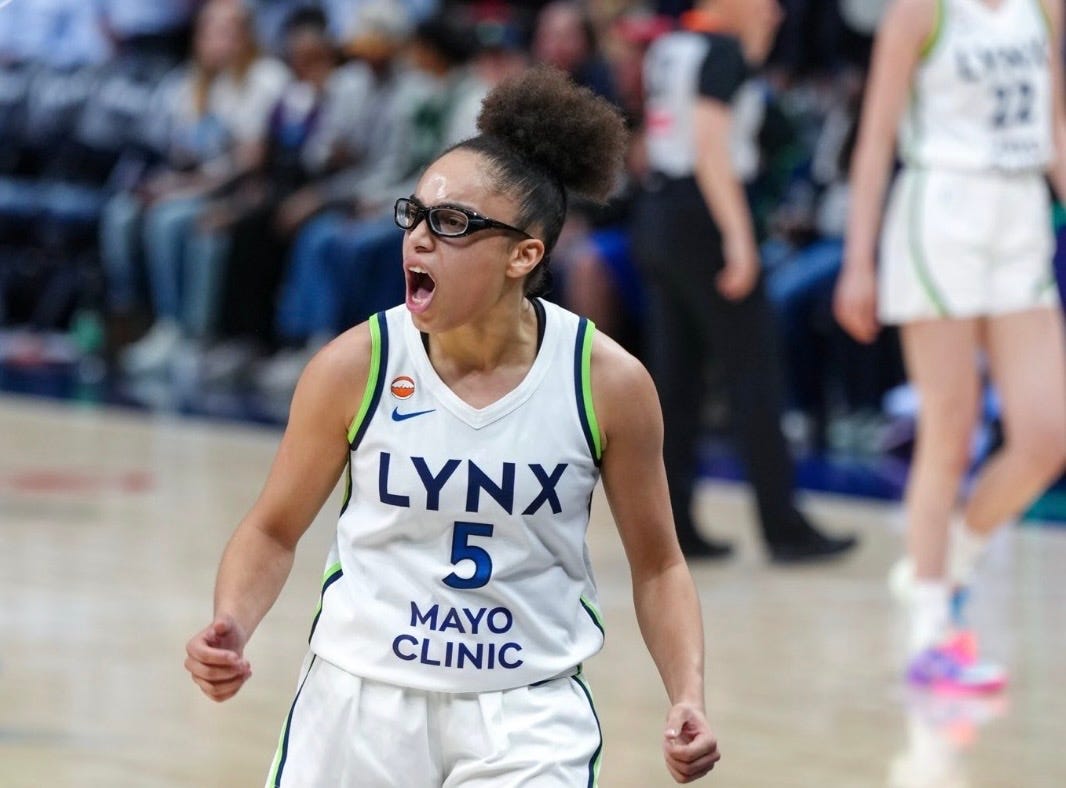
The transition to the WNBA can be especially challenging for rookie point guards. Against the fastest and most physical competition they’ve ever faced, these players are suddenly tasked with quickly assessing elite defensive schemes, organizing veteran teammates, and making split-second decisions. But even when their smallest mistakes are almost always exposed, there are a few rookies who’ve been trusted to run their team’s offense under all of this pressure from day one.
Georgia Amoore, Mystics
An early first-round pick in 2025, Amoore was forced to miss all of what would’ve been her first WNBA season recovering from an ACL injury. But despite the one-year absence from the court, the Mystics have shown complete confidence in her ability to step into the lead guard position. From opening day, they’ve entrusted her with the ball and empowered her to embrace a vocal role on one of the league’s youngest rosters. And the 5-foot-6 guard has responded with composure and confidence. Even while her team is still being rightfully cautious with her playing time and recovery process, Amoore is averaging 5.8 points and 4.3 assists per game through her first four contests, and she looks like a natural in orchestrating the offense, pushing pace in transition, and creating advantages out of the pick and roll.
Although there are still longer-term questions around Amoore’s smaller stature and whether she can consistently create separation against taller, more physically imposing athletes, her strengths are easy to see. She possesses tremendous playmaking instincts, a smooth pull-up from outside, and the kind of competitive edge and advanced feel for the game that could make her invaluable on the court. As she continues to rebuild her conditioning, regain her rhythm, and hone her chemistry with her teammates, her role is likely to expand even further. And considering the lengthy developmental runway and the amount of responsibility the team has already given her, she could be one of the more fascinating storylines to watch among this year’s rookie class.
Pauline Astier, Liberty
The undrafted 24-year-old French floor general joined the Liberty fresh off a terrific EuroLeague season, where she averaged 10.2 points, 3.2 rebounds, 5.2 assists, and 1.9 steals. And through the opening stretch of WNBA games, she’s looked every bit as polished and prepared as advertised. Averaging 16.8 points, 3.8 rebounds, 4.0 assists, and 2.3 steals over her first four games, Astier has wasted little time proving that her overseas experience and high basketball IQ translate to this level. A three-level offensive weapon, she’s showcased a variety of acrobatic finishes at the rim, a reliable pull-up game, and the ability to knock it down from three. A natural connector, she also looks comfortable deploying quick reads, putting teammates in scoring position, and making difficult passes look easy.
On the defensive end, she’s looked equally encouraging, anticipating well in passing lanes, disrupting actions, and holding her own against some of the league’s more athletic guards. As the season progresses, it’ll be intriguing to see whether she can remain a consistent rotation fixture, especially once Sabrina Ionescu recovers from her ankle injury and Leonie Fiebich returns from international play. But if Astier continues to defend at a high rate and provide steady playmaking, she’ll make it difficult for the Liberty to reduce her minutes even after the team gets back to full strength.
Charlisse Leger-Walker, Sun
Coming off a national championship with UCLA, the 5-foot-10 New Zealander has seamlessly carried that momentum into her early regular-season minutes. And she looks far more comfortable than many may have expected for a second-round pick entering a rebuilding situation. From the opening game, Leger-Walker has repeatedly shown a poised demeanor, little fear against top-notch opponents, and high-level passing abilities. Now averaging 6.4 points and 2.2 assists, she rarely appears sped up and consistently makes sure the ball keeps moving within Connecticut’s offensive flow.
While not an elite athlete by WNBA standards, Leger-Walker competes hard on the defensive end, communicates effectively, and has shown a willingness to pressure opposing guards and battle through screens. Her size and knowledge of the game have helped her hold up reasonably well against stronger backcourts, and head coach Rachid Meziane has trusted her with notable defensive assignments earlier than many rookies typically receive. While her role could shift as Hailey Van Lith becomes more comfortable in Connecticut’s system and after Leila Lacan returns from overseas, Leger-Walker should preserve a meaningful role even as the backcourt rotation becomes more crowded if she continues to build on her early-season performances.
Jovana Nogić, Mercury
While the Mercury’s offense runs through Alyssa Thomas as a point-forward hub, the 5-foot-11 Serbian guard has quickly emerged as a complementary and dependable playmaker. She’s comfortable handling ball pressure, initiating sets, and keeping the offense moving without over-dribbling. She also thrives playing off Thomas’ gravity and talent as a distributor. Averaging 15.4 points per game, Nogić is a savvy relocator, attacks closeouts nicely, and can be an absolute sniper from deep (51.7% on 5.8 3PA per game). When initiating actions, she has no problem calling her own number, especially when defenses go under ball screens, and has connected on some very crafty passes while limiting turnovers.
Defensively, the 6-foot-1 rookie has shown veteran positional awareness, active hands, a competitiveness navigating screens, and an ability to hold up physically compared to a typical rookie. And she’s gotten better at making more timely rotations with each game. So while she may not function as a traditional lead guard, Phoenix clearly trusts Nogić’s feel and processing speed, and there is little doubt she’ll continue to be an important part of their core rotation throughout the season.
Olivia Miles, Lynx
Drafted No. 2 overall, Miles immediately became the Lynx’s primary answer at point guard. Playing alongside Courtney Williams in the backcourt, she quickly earned the trust of head coach Cheryl Reeve and is already being relied upon to make the right play in late-game and high-pressure moments. But it’s easy to see why. Through the first four games, Miles has delivered several remarkable performances. Averaging 15.5 points, 5.8 assists, and 4.3 rebounds, her elite IQ and passing ability have helped her pick apart defenses in ball screen actions. She knows exactly when to attack downhill, pull up from outside, or kick it out to an open shooter. She also controls the tempo of the game incredibly well and looks at ease directing more experienced veteran teammates when called upon.
While there’s still room for growth with her defensive positioning, screen navigation, and help-side rotations, the Lynx coaching staff has placed a strong infrastructure around her to minimize its impact. And Miles’ offensive production usually more than compensates for any lapses on the other end. Already being touted in ROTY conversations, if Miles continues to develop as a three-level scoring threat while maintaining her poised decision-making and savvy distribution of the ball, she’ll continue to log major minutes. And with both Reeve and Hall of Fame point guard Lindsay Whalen helping to guide her development, the trajectory of Miles’ growth could make her one of the league’s most exciting young guards to follow for years to come.
Kiki Rice, Tempo
Starting the season coming off the bench and frequently playing alongside Julie Allemand, Rice had been somewhat limited in her lead guard duties. But having a more flexible backcourt role where she could operate on and off the ball allowed Rice to ease into the professional game and figure out how to best add value and make an impact. And when she finally earned her first career start, Rice responded with an impressive 19-point, five-rebound, and two-assist performance. Her pro-ready frame, positional versatility, and high-level basketball IQ make her an asset on both ends of the court. She can initiate primary or secondary actions, doesn’t force bad shots, and has a knack for attacking downhill and finishing through contact. She’s also shown she can be effective from beyond the arc.
On the defensive end, Rice competes with an endless motor on every play, and her combination of strength, toughness, and discipline has helped her hold up well against even the most physical opponents. This type of mindset should also help her improve at handling heavy ball pressure, traps, and blitzes. And as she becomes more confident in these areas, it’s likely that Toronto will assign her more point guard responsibilities. But regardless of whether Rice evolves primarily into a lead or off-ball guard, considering her work ethic, maturity, and competitive drive, there’s little doubt she has the tools to develop into one of the more impactful long-term backcourt players in this rookie class.
Adjusting to the WNBA is rarely seamless for young lead guards. While it’s still early, these rookies have already proven capable of handling one of the league’s most demanding roles. But if these opening weeks are any indication, the future of WNBA playmaking appears to be in excellent hands.
Thanks for reading the Her Hoop Stats Newsletter. If you like our work, be sure to check out our stats site, our podcast, and our social media accounts. You can find me on Bluesky and HHS on Bluesky, Twitter, YouTube, Facebook, and Instagram.
I had my doubts about Amoore, but I saw her in one game, and her quickness and speed were impressive.
That said, her lack of size and defense are an issue. Her Basketball Reference defensive rating (100 is average) is 111, and her offensive rating is 84 (due to poor shooting). To me, she looks like a good backup point guard, but we're in an expansion era, so she's going to get to start somewhere.
Leger-Walker can shoot, but her defensive rating is a horrid 119 -- granted, it's early, small-sample size, etc., but as you mention, she is athletically challenged at this level.
I love Olivia Miles. I thought she should have been 1/1.
Great writeup! It’s still difficult seeing Miles in a Lynx uni after multiple projections (spanning two seasons!) had her being drafted by Seattle. PG was and still is a need for the Storm. Many fans believed Miles would be a key piece to Seattle’s rebuild. Losing Diggins in free agency was expected but painful nonetheless.