
Does Winning the Opening Tip Move Win Probability in NCAA WBB?
What almost 4,500 games say about a play that’s over in a blink


Thanks for reading the Her Hoop Stats newsletter. We’re excited to announce a new partnership with Hudl. Hudl’s industry-leading tools - Sportscode, Instat, and Fastmodel - elevate the preparation, performance, and player development of WNBA and NCAA teams. We appreciate their support and look forward to working with them to help bring more insight about the women’s game to you.
You can find me on Bluesky, Instagram, and TikTok and you can find HHS on Bluesky, Twitter, YouTube, Facebook, and Instagram.
Haven’t subscribed to the Her Hoop Stats Newsletter yet?
This project is inspired by Luke McCartney’s great write‑up on the men’s game, “College Basketball’s Opening Tip Advantage.” I’m basically rerunning his idea on the women’s side, using NCAA women’s basketball data and Her Hoop Stats’ pregame win probabilities.
The opening tip is over in a blink. Sometimes it’s clearly treated as a set piece, with a designed tip-off play and your best jumper in the circle; other times it feels more like a formality before the real action starts. On paper, winning the tip gives you the ball first and the chance at an extra possession compared to your opponent. But does that all wash out over the course of a 40-minute game, or does the result of the opening tip actually move the needle on the game outcome?
Using NCAA women’s play‑by‑play data from the 2025‑26 season and pregame win probabilities from Her Hoop Stats, I looked at every game where we know who won the tip and who was favored. That gave me 4,466 Division I games with both a tip result and a pregame win probability for the eventual tip winner. (One caveat: early‑season predictions are noisier, so part of what you’re seeing here is a check on how well the model and the tip both perform before league play really settles in.)
I follow Luke’s setup pretty closely: for each game, find the team that won the tip, record its pregame win probability and whether it actually won, then define “tip advantage” as the difference between its actual win rate and expected win rate. In other words, the tip advantage for a game is how much better (or worse) the tip winner did than we would have expected going in.
Across the full sample, teams that won the tip won games 57.4% of the time, compared to an expected 56.2% based on their pregame odds. That’s a tip advantage of about 1.2 percentage points, with a 95% confidence interval from roughly 0.1 to 2.4 percentage points. It’s a real, positive effect, but it’s not “recruit a specialist just for jump balls” territory. Over a full season, you wouldn’t hate to have the extra 1-2 points of win probability here and there, but it’s not going to rescue a team that’s badly overmatched in its conference.
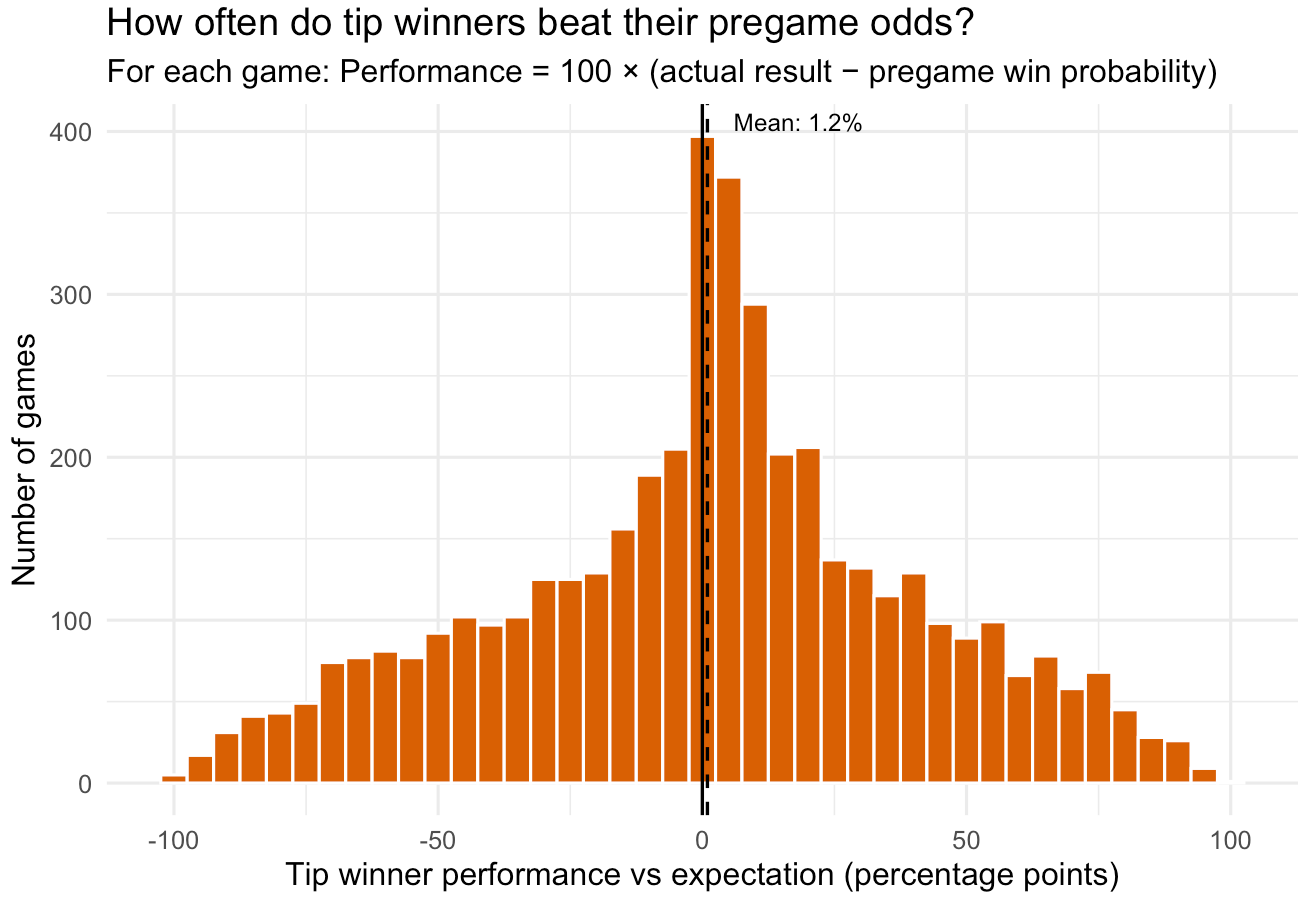
One way to see this is to look only at teams that won the opening tip and measure how they performed relative to their pregame win probability, game by game. In that distribution, most games are clustered near zero, but the bars skew slightly to the right and the average line sits just above zero, meaning that tip winners tend to outperform what the model expected, on average.
Where it gets more interesting is when you break things out by how likely the tip winner was to win before the game. When the tip winner was a heavy underdog (less than 35% pregame win chance), winning the tip was worth about 3.4 percentage points of extra win probability, with the 95% confidence interval running from about 1.4 to 5.5 points. Slight underdogs (35-45%) and toss‑ups (45-55%) also saw positive bumps of about 2-3 points, although the error bars are wide enough that those effects might just be noise. Slight favorites (55-65%) actually came in slightly below expectation, and heavy favorites (65% and up) were essentially flat or a touch negative, with confidence intervals that overlap zero.
For example, Evansville came into UNI on Jan. 25 with only a 4.1% chance to win, won the tip, and pulled off a 68-65 road upset. Earlier that month, Cincinnati beat No. 11 Iowa State 71-63 after winning the opening tip despite only about a 7.5% pregame win probability.
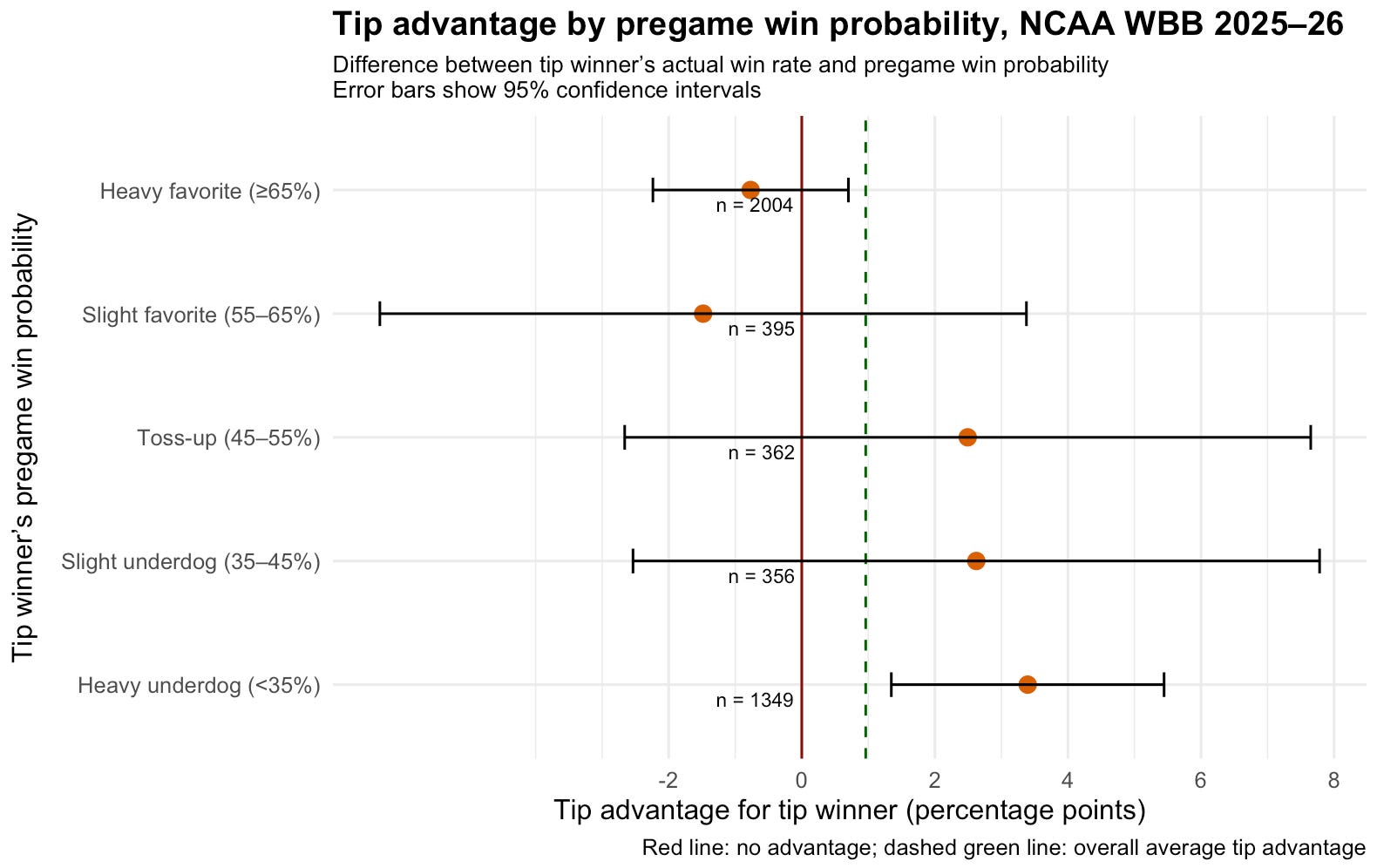
The exact shape of this pattern does depend a bit on how you group teams. In the table above, I used fixed buckets like “heavy underdog (<35%)” and “heavy favorite (≥65%),” which makes the categories easy to interpret. If instead I force each bucket to have about the same number of games by splitting tip winners into five equal‑sized groups based on their pregame win probability, the story looks similar: the lowest‑probability groups still show small positive tip advantages, while the higher‑probability groups cluster near zero with confidence intervals that overlap no effect. The precise numbers move around depending on the binning, but we don’t see any version where a favorite clearly gains a big edge from winning the tip.
So if you’re an underdog, the opening tip might be one of those little edges that help you hang around. Whether that’s the value of a scripted first‑possession look, a confidence boost, or something else in how those teams play is hard to say from this alone. On the other side, heavy favorites don’t seem to get much extra benefit from winning the tip; they’re already expected to control the game, and the extra possession doesn’t move the needle much.
All of this is still correlation, not proof that “win the tip, win the game.” The numbers say, especially for underdogs, that teams who win the tip also win games a bit more often than the HHS probability model thought they would, and that difference is unlikely to be just random chance. They don’t say that the jump ball is the cause of the upset. It could be coaching, execution, personnel, or just the idea that teams who prepare enough to win the tip might also do a lot of other things right. But if you’re an underdog staff looking for small, repeatable edges, treating the opening tip as a real opportunity and not just a formality is a reasonable place to start!
Thanks for reading the Her Hoop Stats Newsletter. If you like our work, be sure to check out our stats site, our podcast, and our social media accounts on Twitter, YouTube, Facebook, and Instagram.
Just a thought: Winning the tip generally means you have a taller and/or more explosive tall player in the center circle, and it never hurts to have the tallest/most explosive tall player on the floor.
Maybe betting lines don't take that factor into account as much as they should when they project winners?
Good stuff! How much of the heavy/slight fav/dog trend could be explained by the S curve of expected point diff to win probability? I.e. if winning the tip is worth 0.5 (or whatever) extra possessions or ~0.5 in terms of point differential per game, then super heavy fav/dog win prob won't move that much just due to where those points are on the S curve. On the other hand, games closer to 50% have a more pronounced slope on the S curve where a marginal 0.5 (or whatever) points result in a bigger bump in win probability.